Tune to 1859 if you feel like it
A=440 is a decision, not a law of nature. MetroGnome ships sixteen reference pitches — Verdi's 432, Baroque 415, the French Diapason Normal of 435, Chorton 466 — browsable by era, region and instrument, each with a note on where it came from. Pick one and every tuning in the app follows.
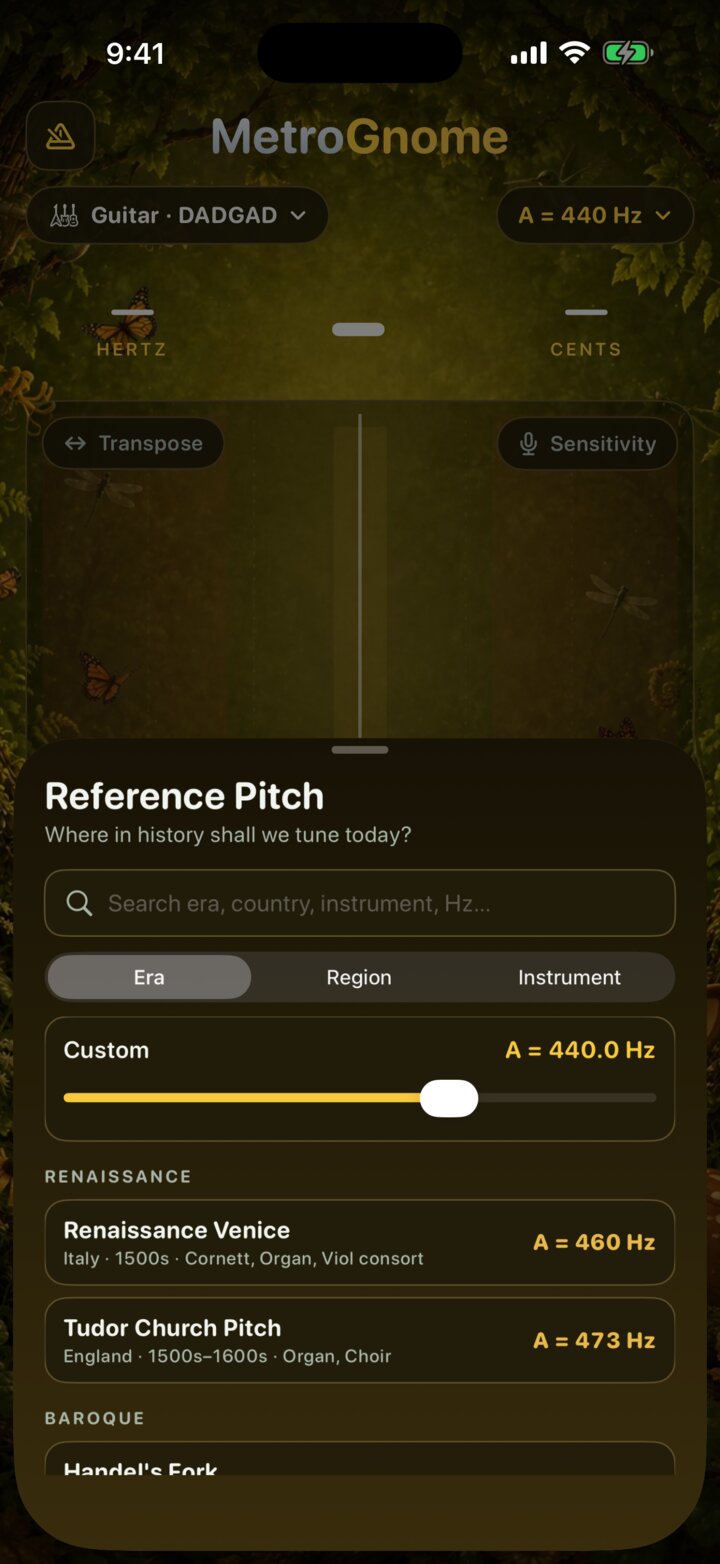
The pitches, and where they came from
Ten highlights from the sixteen in the app.
A=440 · Modern Standard
The international concert pitch since 1955 (ISO 16) — the default everywhere, including here.
A=442 · European Orchestras
The quiet upward drift of continental concert halls — a touch brighter under the bow.
A=443 · Berlin
Where the Berlin Philharmonic sits. Match the recording you're practicing against.
A=445 · Vienna
Brighter still — the Viennese preference at the top of the modern range.
A=432 · Verdi's Pitch
The lower standard Verdi campaigned for in 19th-century Italy, gentler on voices.
A=435 · Diapason Normal
France's legal pitch of 1859 — the first national tuning standard.
A=452 · Old Philharmonic
Victorian Britain's high concert pitch, before the world agreed to come back down.
A=415 · Baroque
The modern early-music convention — a semitone below 440, home of harpsichords and traversos.
A=466 · Chorton
The high church pitch of the German Baroque — organs ran sharp, and everyone followed.
A=392 · French Baroque
The low, dark pitch of the French opera orchestra in the age of Lully and Rameau.
…plus six more in the app, filed by era, region and instrument.
History you can tune to
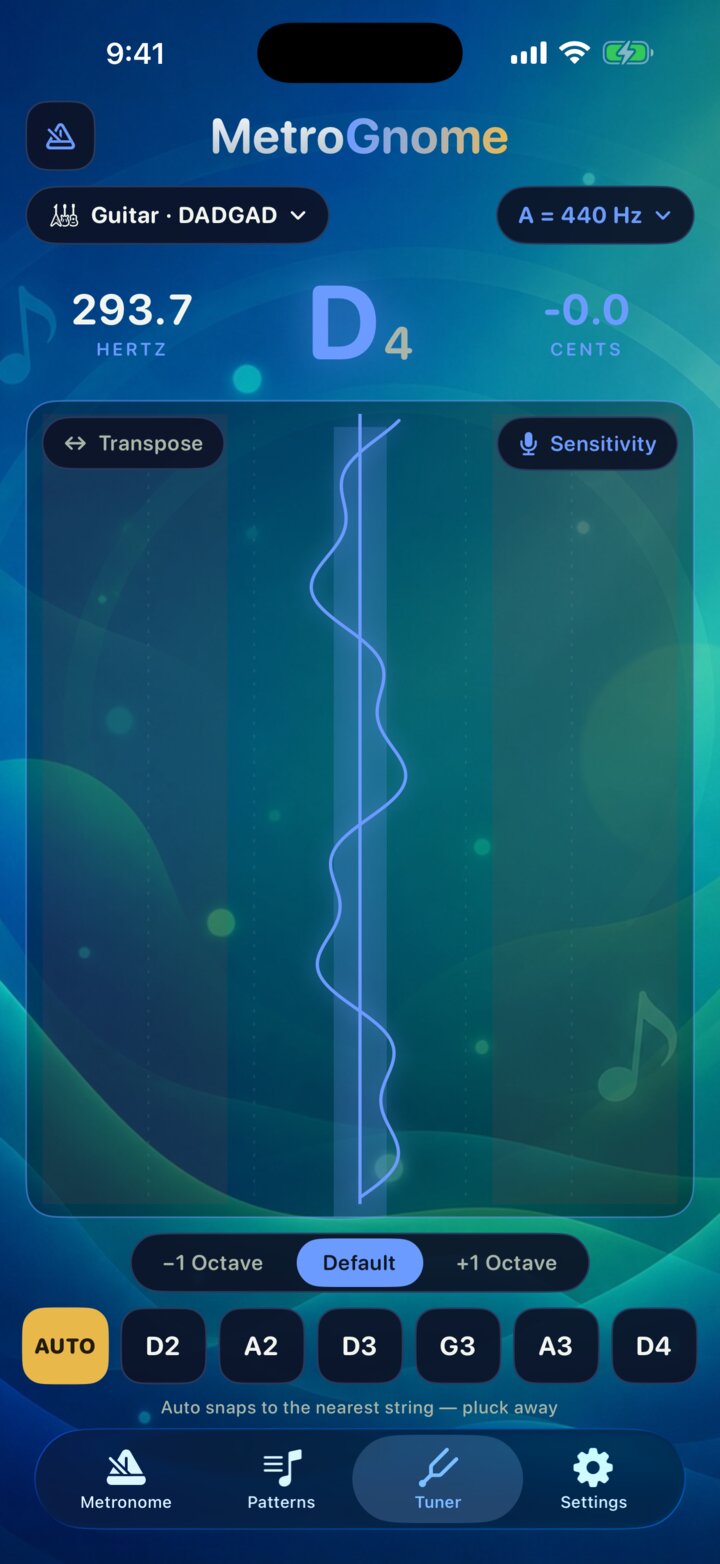
Every pitch in this library is live in the tuner. Choose your A, then hand it to whatever you play — a requinto, a cello, a five-string banjo — and tune there directly.
- Five instrument families — guitar, bass, ukulele, bowed strings and folk — sixty tunings in all, from DADGAD and BEAD to high G, plus a chromatic Any Note mode for the rest.
- No math on your end — pick Baroque 415 and the tuner does the semitone drop for you, string by string.
Reference pitch FAQ
Can I tune to 432 Hz?
Yes — set the reference to A=432 and every tuning in the app follows it. It's included as Verdi's pitch, the lower standard the composer campaigned for; whether you use it for history or for taste is your business.
What is Baroque pitch, A=415?
The modern early-music convention for Baroque repertoire — almost exactly a semitone below A=440, chosen so period instruments can play together consistently. For the full period picture, the app also carries French Baroque A=392 and Chorton A=466.
Why do some orchestras tune above 440?
A slightly higher reference gives strings a marginally brighter, more brilliant sound — 442 across much of Europe, 443 in Berlin, 445 in Vienna. Pick the one that matches the ensemble or recording you're playing with.
Does the reference pitch change the metronome?
No — it only affects the tuner. Tempo is tempo.
Four centuries of A, one pocket
The gnome has been tuning since before 440 was cool.